
Dissolution Highlights from the 2009 AAPS Annual Meeting in Los Angeles
Gregory P. Martin
Complectors Consulting
Pottstown, PA
The AAPS 2009 Annual Meeting provided a wealth of opportunity for dissolution enthusiasts.There was a variety of programming focused on dissolution testing, including a Short Course on biorelevant dissolution, several roundtables, a symposium on Dissolution for Testing of Nutraceuticals, and meetings of the In Vitro Release and Dissolution Testing Focus Group (IVRDT FG). The programming provided insights into both the complexity and potential value of dissolution testing and provided valuable topics for discussion.
Short Course: Developing Biorelevant Dissolution Methods with an Emphasis on QbD
The week started with a very interesting short course moderated by Vivian Gray, Dissolution Technologies, and Andreas Abend, Merck, that traced the utility of biorelevant dissolution from the identification of patient needs and formulation selection during early phase product development through late-phase justification of methods and specifications using a QbD approach. In the first talk,"Biorelevant Dissolution Testing: Characterizing the Product for the Patient," Arzu Selen, FDA, pointed to the criticality of the Quality Target Product Profile and suggested that biorelevant dissolution may facilitate development of an IVIVC. In her talk titled "Biorelevant Dissolution Method in Early Phase Drug Development," Yun Mao, Merck, discussed the value and potential pitfalls of biorelevant dissolution in the early development of poorly soluble compounds, especially for formulation selection. She pointed out the need to understand the chemistry of the molecule and pH dependence of solubility for optimum results.This approach was further supported by Nikoletta Fotaki, University of Bath, in her talk "Developing a Biorelevant Dissolution Method: Points for Consideration and Case Studies." She provided several illustrations showing that predictive dissolution testing can be used throughout development. In his talk, "Modeling and Simulation Approaches for Designing and Understanding In Vitro Dissolution Tests," John Crison, Simulations Plus, indicated that modeling approaches can aid in understanding the dissolution process and decreasing resources, including costs and time to market. The value of biorelevant dissolution was discussed by Andreas Abend, Merck, in his talk "QbD Approach to Dissolution through Understanding of the Release Mechanisms and Critical In Vivo Parameters."This approach couples the Target Product Profile and variations in formulation or manufacturing parameters to demonstrate acceptability at later phases.There was an excellent presentation on the "Role of Design of Experiments in Developing Biorelevant Methods" by Kimberly Gallagher, Merck, which demonstrated the value of statistical experimental design in understanding the effects of variation in dissolution conditions.
There was a lively panel discussion in which the value of a database of case studies using biorelevant dissolution became apparent, and there were some questions about the usefulness of animal data in predicting dissolution in humans. Perhaps the biggest question was whether QC dissolution tests should be the same as the biorelevant tests or independent from them. As Dr. Selen pointed out, "We are all learning."
Roundtable: IVIVC for Establishing Clinically Relevant Specifications
Since in vitro testing plays a dual role (i.e., indicator of product quality or predictor of in vivo performance), this Roundtable presented an opportunity to bridge the knowledge gaps between the two roles. Arzu Selen, FDA, started the Roundtable with a presentation titled, "Challenges in Setting Clinically Relevant Dissolution Specification from In Vivo and In Vitro Correlations," in which she pointed out that challenges can be product-related (e.g., Biopharmaceutical Classification System, BCS), patient-related (e.g., BCS or Biopharmaceutical and Drug Disposition Classification System, BDDCS), related to the interfaces between products and patients, or method-related (e.g., if equipment and conditions are not optimized). Nikoletta Fotaki, University of Bath, followed with a talk titled, "Predicting In Vivo Performance from In Vitro Data," discussing the need for a predictive dissolution test (including medium and apparatus) and an understanding of in vitro release rates versus in vivo absorption rates to assist in understanding simulated profiles. Finally, Mario Gonzalez, P�Kinetics International, presented "IVIVC: Factors and Conditions for Success," where he stressed the need to attain a Level A correlation, since Level B or C do not really provide leverage with regulators. He also pointed out that it is probably necessary to use commercially available software programs for effective numerical deconvolution or convolution.
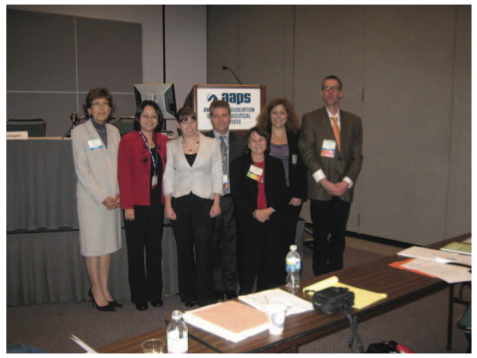
Speakers and Moderators for AAPS Dissolution Short Course: Arzu Selen, Yun Mao, Kimberly Gallagher, John Crison, Vivian Gray, Nikoletta Fotaki, Andreas Abends
In the roundtable discussion that followed, a number of interesting points were brought out. While a valid value for Ke (elimination rate constant) is necessary for developing an IVIVC, it is not always easy to determine. Developing formulations that result in slow, medium, and fast release (which is very desirable for developing correlations) is often very challenging from a manufacturing perspective. For dissolution testing, we normally use 900 mL, which is much higher than the volumes encountered in the body and may help explain the difficulties in determining Ke. If a complicated dissolution method is required to develop a good IVIVC, how do we transition to a simpler method that is practical for QC? Is it worthwhile to have a QC method if it is not biorelevant?
Symposium: Challenges and Application of Dissolution for Testing Nutraceuticals, Natural Products, and Traditional Medicines
This symposium was particularly fresh and interesting. The complexity of phytochemical mixtures in herbal dietary supplements and traditional medicines presents multiple challenges for the development team, especially for the analytical chemist. In contrast to pharmaceutical products, nutraceuticals often contain several different natural products, and each of these is likely to contain multiple ingredients, some or all of which may be active. This makes the process of developing a dissolution test significantly more complicated than the process for a pharmaceutical product, which typically contains one or two well-characterized active ingredients. Compendial standards for nutraceuticals and natural products are in their infancy, and there are currently only four herbal monographs published in the USP that specify dissolution parameters. There is very little published on the application of dissolution in the development and testing of natural and nutraceutical products.
Raiman Loebenberg, University of Alberta, presented the first talk,"Perspectives on Dissolution of Natural Products," referring to USP <2040> on Disintegration and Dissolution of Nutrition Supplements and potential use of a seven-compartment model and GastroPlus software to model dissolution. He pointed out that for Ginko Bilboa, a relatively simple product, there were significant differences among brands, and there is difficulty in selecting a marker substance among the many peaks, since it is not clear which have clinical significance. He raised the question of whether BA/BE studies would ultimately be necessary for nutritional supplements, pointed to the challenges of determining which are the important components, and noted that revenue streams would probably not support the types of bioequivalence studies often used for pharmaceutical products.
In his presentation,"Use of Dissolution Technology to Identify and Develop Standards, Leading to Analysis of Actives from Dissolutes of Feverfew," Robert Chapman, Midwestern University, invoked the Dietary Supplement Health Education Act (DSHEA), indicating the need to identify the plants (and parts thereof ) used in the product and the names and amounts of active or marker compounds. He also indicated there is currently no requirement to prove efficacy or assure bioavailability. He used Feverfew as a model product. Used for migraines, it is widely available from multiple manufacturers. There is a USP monograph available, which calls for analysis by HPLC and which Dr. Chapman used to evaluate whether samples from ten different sources met the requirement of NLT 0.2% (w/w). However, this does not address the question of whether or not the products are bioavailable or bioequivalent.
In an effort to characterize products containing botanical extracts, Janjira Intra, Nutrilite Health Institute, used USP Apparatus 2 with hollow-shaft, direct-UV determination to evaluate the impact of variation in the manufacturing process, including tablet hardness, type of coating material (methyl cellulose vs HPMC), and type of granulation, on dissolution results. In his talk,"Method Development for Dissolution Testing of Immediate-Release Tablets Containing Standardized Botanical Extracts," she discussed the challenges of working with products containing multiple botanical extracts, each of which contains a variety of phytochemicals.
John Duan, FDA, made the last presentation, titled "QbD Approaches to Dissolution of Nutraceuticals and Traditional Medicines." Dr. Duan reviewed how dissolution can be used to distinguish between batches of differing quality and suggested using a risk-assessment approach to manage the potential risks for nutraceuticals, especially considering their complexity (e.g., milk thistle typically contains three components, one of which, silybin, is considered the most active).
The panel discussion focused on some of the challenges characteristic of nutraceuticals: multiple components, many peaks, high variability within and between manufacturers with little regulatory guidance and few compendial monographs. They pointed out that, because revenues from nutraceuticals are much lower than from prescription drug products, testing must be practical and cost effective. These considerations are in addition to those frequently discussed for prescription drug products, including gelatin cross-linking in capsules, coning of insoluble ingredients, and potential use of rupture testing for soft gelatin capsules.
Roundtable: Alcohol Dose Dumping for Extended- Release Solid Oral Dosage Products (APQ)
In the first presentation, Stephen P. Mayock, Vertex, showed several examples of the effect of the presence of alcohol on in vitro release profiles in his talk on "Effects of Alcohol on In Vitro Release of Various Commercially Available Extended-Release Formulations." He also discussed approaches to formulation development that can reduce the effects of alcohol on dose dumping.
Mansoor Khan, FDA, examined safety aspects from a regulatory perspective for both "drugs of abuse" and narrow therapeutic range drugs in his presentation "U.S. Food and Drug Administration Perspective on Alcohol Dose Dumping Including a Historical Perspective."
The discussion that ensued indicated that this is an area of concern for the industry and that further guidance on acceptable approaches would be valuable.
Roundtable: Comparator Products�Untold Stories
Conducting global clinical studies for later phases of development (Phases II�III) requiring the use of comparator products presents an array of CMC challenges. This roundtable discussed some of those challenges, including approaches to development of dissolution methods for comparator products, regulatory concerns, and strategies for meeting regulatory expectations in global clinical trials.
Xujin Lu, BMS, set the stage in his presentation "Development of Dissolution Methods for Comparator Products�Unspoken Challenges" and indicated that regulators expect comparator-controlled clinical studies, typically using the most widely prescribed or �gold standard� product. However, when dealing with a competitor�s product, there is a lack of experience with the product, the formulation, and the analytical methods; typically compressed timelines; limited resources; and relatively little regulatory guidance. Dissolution methods may be a critical test for these products, particularly if the products are manipulated to blind them. Methods are sometimes available in the compendia or the FDA dissolution database, but often must be developed in-house, subject to the constraints just mentioned. In many cases, acceptance criteria are unknown, making it difficult to draw conclusions regarding the acceptability of the product. Most firms have developed some in-house criteria to address both method development and establishment of acceptance criteria, based on best practices. Since many products are blinded by over-encapsulation, a recurring problem has been observed due to cross-linking of gelatin capsules, necessitating use of multi-tier tests that include pepsin to overcome the effects of cross-linking. This is further complicated by the presence of surfactants in the dissolution media, which is more common since many compounds today are poorly water-soluble.
A regulatory perspective,"Comparator Products: Why Should We Care?" was prepared by Dakshina Chilukuri, FDA, and presented by Capt. E. Dennis Bradshaw, FDA. First and foremost, we need to assure the validity of study results. However, if counterfeits are used, we may draw the wrong conclusions. Various techniques may be used to blind the comparator for both appearance and taste, and there is a potential that these techniques (over- encapsulation, film coating, deprinting, reformulation, etc.) could change the in vitro release profile or the systemic exposure. He presented an example in which a BE study comparing an unmodified comparator to the modified form showed a difference in Cmax, which was significant for the study. With in vitro tests, it may be difficult to ascertain whether the test is sufficiently discriminating, or perhaps over-discriminating, relative to the in vivo performance. For international trials, the issues become even more complicated; there may be multiple sources of products, they may not be approved in all the regions in which the study is being performed, and sourcing of the product may result in quality concerns. Discussions with FDA may be useful to avoid unanticipated problems.
Ravi Harapanhalli, FDA, provided some practical suggestions in his presentation,"Regulatory Expectations for Comparator Products Used in Clinical Trials."The purpose of the study must be established up front, whether it is to establish therapeutic equivalence for a generic, to establish superiority or non-inferiority for a new chemical entity, or to establish the acceptability of a follow-on biologic (an area in which the U.S. is lagging some other regions). Typically, the selected comparator product will be nationally approved where the trial will be conducted and will be the most widely prescribed product. Sourcing issues will have been resolved to avoid potential quality issues, and the strengths to be used will have been decided. The ruggedness of the comparator product relative to any modifications will have been established, and the history of the product will have been reviewed (e.g., recalls, global availability, reported BE issues examined, import/export issues resolved). Dr. Harapanhalli then pointed out some of the challenges related to execution. There may be variations in batch size; multiple set-ups or manufacturing sites may be necessary.There may be variability in capsules used for over-encapsulation. Any excipients introduced should not only be inactive but also have no impact on product quality. From a CMC perspective, it is necessary to establish the packaging to be used, the testing and specifications (perhaps including degradates), the stability of the modified product, and BA/BE when necessary.There may be legal challenges, such as when visible branding or logos are removed, or when a unique product shape is involved. If the comparator is a controlled substance, DEA regulations must be addressed in the U.S., and the requirements may be different in other countries.
Dr. Harapanhalli suggested some "Good Blinding Practices." Changes to the original product should be minimized to the extent possible and should have no significant impact on product quality. Comparative dissolution should be performed (in multiple media when appropriate; BA/BE should be established when needed). Expiry dates should be justified, and modifications documented in batch records and filed in the IND.
The discussion following the presentations was lively, touching on some of the expected topics. Since over- encapsulation is widely used for blinding comparators, cross-linking of gelatin capsules was a hot topic, and complications when surfactants are present in the dissolution media were discussed. There were questions on how often BE studies are needed and how much time is needed to prepare for inclusion of a comparator in a clinical study. Several members of the audience pointed out that project management and clinical supply logistics are important; it was noted that about 30% of studies are delayed, often due to logistical issues related to comparators, including import/export issues.
IVRDT Focus Group meeting
The Annual Membership Meeting of the IVRDT Focus Group was held on Wed., Nov 11. Over 25 members were present. The goals of the Focus Group are related to in vitro release testing and include exploration of new technologies, application to novel dosage forms, issues in method development or instrument qualification, biorelevant dissolution testing, application of BCS and biowaivers, and setting of specifications. Steve Mayock, chair of the Focus Group Steering Committee, and Alger Salt, chair-elect, reviewed an impressive list of accomplishments for the group in 2009. These included setting up most of the programming related to dissolution testing for the AAPS Annual Meeting (discussed earlier in this article); Outreach Programs, which included two-day workshops on "Challenges in Dissolution Testing" in India and Africa and promotion of several publications related to dissolution testing, including themed issues of Dissolution Technologies on Biorelevant Media for Dissolution and the AAPS Journal focused on Dissolution; and publication of the Focus Group�s first newsletter. Mr. Mayock also presented a summary of the responses to a survey on dissolution instrument performance qualification, which indicated that about 26% of respondents are now using mechanical calibration instead of the performing the USP Performance Verification Test. Many are waiting for further guidance from the FDA on the acceptability of mechanical testing or modification of the mechanical testing to address perceived shortcomings (e.g., vibration and vessel symmetry). The meeting ended with a call for topics for 2010 and an invitation for new members to join. More information about the Focus Group, including some recent presentations and the newsletter, can be found at www.aapspharmaceutica.com/inside/Focus_Groups/InVitro/index.asp
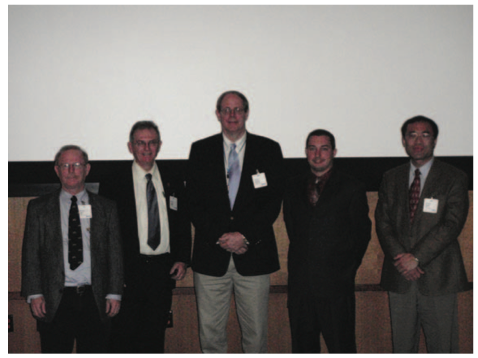
Speakers for Focus Group Face-to-Face Meeting: Alger Salt, Greg Martin, Steve Mayock, Jon Kretz, Xujin Lu
IVRDT Steering Committee Face-to-Face Meeting
A face-to-face meeting of the IVRDT FG Steering Committee was held in Thousand Oaks, CA, on the day following the AAPS Annual Meeting. The meeting included five presentations by Steering Committee members, which were presented on Webex in addition to the live audience. In his presentation on "Dissolution and Early Phase Specification Setting," Jonathan Kretz, Amgen, discussed some of the challenges during early development when the number and size of batches are small. Greg Martin of Complectors Consulting and Xujin Lu, BMS, gave talks on comparator agents that reviewed some of the challenges and pitfalls associated with using products for which limited information is available. Alger Salt, GSK, provided an intriguing presentation on "The Quality by Design Approach to Developing and Validating Dissolution Test Methods" in which he encouraged developers to update their thinking. Finally, FG Chair Steve Mayock, Vertex, presented some practical resource-sparing ideas in his talk,"Approaches to Developing the Disintegration Test as an Alternate to Dissolution." After discussion on the presentations, the Steering Committee adjourned for a business meeting.
The AAPS Annual Meeting provided an excellent opportunity for those interested in dissolution to hear about recent developments and to participate in discussions on challenges encountered by many in the industry. With emerging practices in areas like biorelevant dissolution, nutraceutical testing, and challenges related to comparators, it is important to maintain an awareness of current thinking, and the AAPS presented a concise way in which to accomplish this goal.
If you are interested in being involved in the focus group and are a member of AAPS, let the organizers know. For the organizers' e-mail information, contact the Research Editor, vgray@dissolutiontech.com