Questions and Answers May 2026
Margareth R. Marques, Ph.D. and Mark Liddell, Ph.D.
The following questions have been submitted by readers of Dissolution Technologies. Margareth R. Marques, Ph.D., and Mark Liddell, Ph.D., United
States Pharmacopeia (USP), authored responses to each of the questions. *Note: These are opinions and interpretations of the authors and are not
necessarily the official viewpoints of the USP.
Email for correspondence:
mrm@usp.org
Q Regarding the use of USP apparatus 5, paddle over disk, for the drug release testing of transdermal systems, we are using 500 mL of dissolution medium. Figure 1b in the USP general chapter <724> Drug release shows the use of four clips to hold the screen and the watch glass. If we use the four clips, then the watch glass is going to be too high in the vessel, and with 500 mL of medium, it is going to be difficult to sample at the appropriate position, as described in the chapter. By removing one or two clips the watch glass will sit lower, and it will allow us to withdraw the samples as required. We would like to know if this new condition is acceptable.
A As stated in the chapter "other appropriate devices may be used, provided they do not sorb, react with, or interfere with the specimen being tested." Thus, it is not mandatory to use four clips as described in the chapter; any other suitable configuration can be used as long as the transdermal system and holder remain stable at the bottom of the vessel and do not move during the test.
Q We would like to know the allowed variability on the rotation speed in the dissolution test.
A See USP general chapter <711> Dissolution. For USP apparatus 1 (basket) and apparatus 2 (paddle), the tolerance is within ?± 4% of the stirring rate specified in the method.
Q Are there any specific performance qualification tests that need to be done on the disintegration apparatus outside of what is performed in the Installation Qualification / Operation Qualification?
A The disintegration equipment should meet the specifications for the measurements, materials, and assembly, as stated in the USP general chapter <701> Disintegration. Regarding the instrument performance, the stroke rate and stroke distance should be confirmed as part of the instrument qualification. From a day-to-day operational standpoint, the fluid surface height at the bottom and top of the stroke should be confirmed such that the wire mesh remains at least 15 mm below the surface of the fluid at the highest point of theupward stroke and descends to no less than 25 mm from the bottom of the vessel on the downward stroke. The operator should also confirm that the top of the basket-rack assembly does not become submerged at any point.
Q The USP general chapter <701> Disintegration states that the immersion fluid is to be kept at 37 ?± 2 ?°C. Is there a requirement for the temperature of the water bath bar?
A No. The temperature of the water bath should be set to a temperature such that it maintains the temperature of the immersion fluid at 37 ?± 2 ?°C throughout the entire duration of the test.
Q The dissolution acceptance criteria for a particular product is not less than (NLT) 80% (Q) of the labeled amount of drug substance is dissolved. If one unit has a result of 114% but the average of six results is 100%, would this result be valid?
A The dissolution results for immediate release dosage forms are evaluated using the Acceptance Table 1 in the USP general chapter <711> Dissolution (reprinted with permission from USP):
Stage Number Tested Acceptance Criteria S1 6 Each unit is Q + 5%. S2 6 Average of 12 units (S1 + S2) is ? Q, and no unit is < Q ? 15%. S3 12 Average of 24 units (S1 + S2 + S3) is ? Q, NMT 2 units are < Q ? 15%, and no unit is < Q ? 25%.
Q Is the amount of drug released at infinity point in dissolution comparable to the assay result, such that it can be compared to content uniformity?
A Infinity point (i.e., after collecting the sample at the last time point in the dissolution profile, the rotation speed is increased and the test is run for an extended period of time to extract as much drug substance as possible) is used to have an idea of the maximal amount of drug that may be released from the dosage form under extended dissolution conditions. It does not always have a direct correlation to the assay results because assay and uniformity of dosage unit samples are typically prepared using different methods. The infinity point can give you the total amount of drug released from each unit individually, but it represents the amount of drug released under dissolution conditions only.
Q Can the amount of drug obtained at the infinity point in dissolution testing be a replacement for the content uniformity test?
A As discussed above, the infinity point is not typically used in routine analysis. Normally, the infinity point is used during method development or formulation assessment to provide an understanding of the total amount of drug present and released from the sample under specific dissolution conditions. In addition, the sample is prepared using a different method for a content uniformity test. A content uniformity sample will typically be prepared using test conditions and methods like those used in the assay test.
Q Is it necessary to adjust the level of water in the dissolution equipment bath when using volumes of dissolution medium such as 500 or 250 mL.
A The recommendation is to keep the level of water in the bath above the level of dissolution medium in each vessel to keep the temperature of the dissolution medium at the temperature stated in the dissolution procedure. Whether it is necessary to adjust the level of water in the dissolution bath may depend on the mechanism used to secure the dissolution vessels to the vessel plate. In some cases, when the level of dissolution medium in the vessel is below the water level of the bath, the vessels may float and become unstable. It is best to adjust the water level in the bath high enough to maintain the temperature throughout the test, and low enough to ensure that the vessels are secure during the entire test.
Q Can apex vessels be used during the implementation of a dissolution test when there is no specific recommendation to use any vessel in a specific USP monograph? For example, can apex vessel be used in the dissolution tests in the USP monographs for Ciprofloxacin hydrochloride tablets and Fexofenadine hydrochloride tablets, as the monograph does not specify the type of vessel?
A Each USP monograph that has a dissolution test has the entry shown below: 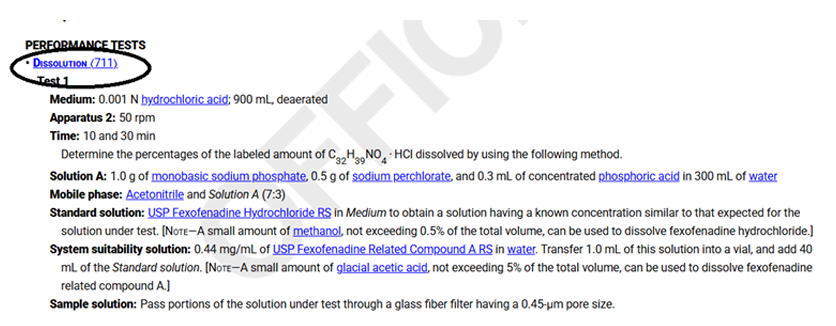
The reference to Dissolution <711> is an indication that all the dissolution test conditions are consistent with those stated in <711> Dissolution. If the product was approved with conditions that differ from those stated in <711>, the specific conditions should be described in the monograph. Consequently, if the monograph does not specify any vessel, it means that the default vessel to be used is the one described in <711>. While there have been efforts to standardize the specifications for apex vessels, currently they are not standardized or described in any pharmacopeia. Therefore, like any noncompendial test method, they can only be used with appropriate scientific justification.
Q Regarding the use of pancreatin in a dissolution medium, in the "Determining Solubility and Stability of Drug Substance in Various Media" section of <1092> The Dissolution Procedure: Development and Validation, it is indicated that simulated intestinal fluid could be used as a typical medium. Could this medium be used in a product where cross-linking due to the gelatin coating is evident, or in what cases could it be used? Also, compared to <711>, there is a significant difference in the amount of pancreatin added to the medium.
A The conditions for the dissolution testing when there is evidence of the presence of cross-linking in gelatin capsules is described in the general chapter <711> Dissolution. The selection of the specific medium will depend on the solubility of the drug molecule. Further, the selection of an appropriate enzyme to be used to overcome the effects of cross-linking will depend on the pH of the dissolution medium. More information is in chapter <1094> Capsules - dissolution testing and Related Quality Attributes.<br>The preparation instructions for simulated intestinal fluid provided in the Test Solutions and Indicator Solutions section of the USP-NF are general instructions and use grams of pancreatin powder, whereas in <711> Dissolution, the amount of pancreatin powder is expressed in units/L of dissolution medium. The actual amount of pancreatin powder, in grams, that one needs to add to the dissolution medium will depend on the activity of the specific lot of pancreatin.
Q In a scenario where a test is conducted with six tablets, and an equipment malfunction occurs-such as a failure to collect a sample from one vessel at a specific time point, or any other clearly identifiable equipment-related issue affecting a single vessel-would it be acceptable to repeat the test using one additional tablet and combine its results with the five valid results from the initial run?
A There are no official recommendations for such a situation, but it would be appropriate to consider the entire run invalid, document everything, and start the test again with six new units. The rationale for this approach is that the dissolution experiment with six tablets is intended for a single run with all tablets tested on the same equipment, by the same analyst. Running an additional run for the single failed tablet introduces an additional source of variability, specifically, run-to-runvariability. Ultimately, the scenario should be discussed and evaluated internally, and discussions should include the quality assurance group.